
SolarEnergies.ca has released a new consumer guide titled “What To Do If Your Solar Panels Underperform in Canada,” after a growing stream of Canadian homeowners reported a familiar stress test: the utility bill arrives from BC Hydro or EPCOR, the balance is not near zero, and the solar monitoring app shows output down double digits. The guide frames the problem in plain terms: most underperformance disputes are not about “bad panels,” but about expectations that were sold as certainty, then quietly softened by contract language once real weather, real shading, and real grid events showed up.
https://www.youtube.com/watch?v=iXrRvt5apYY
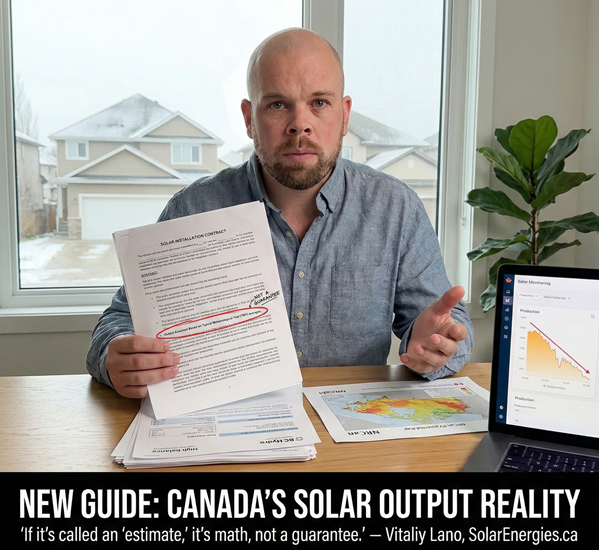
The publication points readers to a foundational truth that often gets lost during a sales pitch: production numbers shown in proposals are modeled outcomes built on assumptions, not guarantees. Solar design platforms commonly rely on Typical Meteorological Year-style datasets and long-term climate baselines to estimate output, which helps standardize projections but can also create a gap between “average conditions” and an actual winter stretch in a specific neighborhood.
Vitaliy Lano, owner and editor at SolarEnergies.ca, said the goal of the guide is to help Canadians protect the economics of their system before a shortfall becomes a fight. “A solar system can be installed perfectly and still disappoint if the contract treats production as a best-case estimate,” Lano stated. “That’s why SolarEnergies.ca keeps pushing the same boring idea: read the paperwork like it matters, because it does. Canada goes Solar - but it should go solar with eyes open.”
The release highlights several data points that SolarEnergies.ca uses to anchor expectations. Natural Resources Canada publishes photovoltaic potential mapping in kilowatt-hours per kilowatt installed (kWh/kWp), showing how much location alone can swing a projected annual number. The IEA PVPS national survey reports have used an average yearly Canadian PV potential assumption of about 1,150 kWh/kWp for estimating production at a national level, which means an 8 kW system might pencil out around 9,200 kWh per year on a long-term average - before roof geometry, shading, orientation, local weather anomalies, and system losses enter the conversation.
SolarEnergies.ca’s guide also addresses the winter reality that homeowners feel most sharply: snow and short days can hit hard month-to-month, even when annual losses from snow may be smaller than many people assume. A five-year Edmonton study led by NAIT’s Alternative Energy Technology program reported roughly a 3% annual energy loss attributed to snowfall on panels, a figure that challenges older “industry assumptions” that were much higher. The guide warns that “small annual” can still feel brutal in the moment when a homeowner is counting on winter production to carry a financing payment or to keep net metering credits on track.
Lano said the most common disappointment starts with a simple mismatch: an “estimate” is treated like a promise. “If a document calls production ‘estimated,’ then it’s usually just math, not accountability,” Lano commented. “A real production or performance guarantee is written as a commitment with a measurement method and a remedy. Without that remedy, there’s often nothing to claim.”
SolarEnergies.ca also calls attention to monitoring disputes - less glamorous than panels and inverters, yet often central in disagreements. “Monitoring gaps don’t magically erase generation, but they do erase certainty,” Lano expressed. “If the portal shows zeros because the system was offline, a homeowner loses easy proof of what happened. That’s when a simple issue turns into a messy one.” Enphase notes that once a gateway is reconnected, it may take time for backed-up data to re-sync to the cloud, which can create confusion if homeowners expect instant data continuity after a router reset or internet outage.
The guide also tackles gradual performance decline. SolarEnergies.ca cites long-running research compiled by the U.S. National Renewable Energy Laboratory that collected nearly 2,000 measured degradation rates across modules and systems, with a median value around 0.5% per year. That trend matters because many homeowners compare Year 5 output to Year 1 expectations without recognizing that warranties and performance curves are typically written with decline baked in.
Beyond the technical explanations, the new SolarEnergies.ca article is blunt about where many claims fall apart: exclusions. Shading clauses can shift responsibility to the homeowner when new obstructions appear. Maintenance language can push snow clearing, soiling, and basic upkeep into “owner duty” territory. Measurement language can define how “expected production” is calculated, including whether output is assessed against weather-adjusted baselines. SolarEnergies.ca does not present these as universal rules; it frames them as recurring patterns that Canadians should verify in their specific documents.
Lano said SolarEnergies.ca sees a practical way forward that does not require homeowners to become engineers or contract lawyers. “The checklist is simple,” Lano suggested. “Find whether there’s a production guarantee, see how it’s measured, see what voids it, and see what happens if the number is missed. If the contract avoids those details, that’s the answer right there.”
SolarEnergies.ca described the article as part of its broader mission: making solar decision-making easier for regular households, especially during the late-winter and spring sales wave when homeowners are most likely to be shown polished ROI charts. The publication also encourages Canadians to cross-check any proposal against third-party, Canada-relevant baselines like NRCan PV potential mapping, and to treat “typical year” assumptions as a planning tool - not a promise of a specific utility bill outcome.
“This isn’t anti-solar. It’s pro-results,” Lano added. "Solar works across Canada. The win comes from honest expectations, clean data, and contracts that don’t dump every risk onto the homeowner.”
For more information about solar energy in Canada and a free solar calculator, visit the company's website.
###
For more information about Solar Energies In Canada SEIC, contact the company here:
Solar Energies In Canada SEIC
Vitaliy Lano
2368680609
admin@solarenergies.ca