
New California law allows courts to consider gun restriction violations when determining child custody in domestic violence cases. Beginning January 1, 2026, California courts can consider firearm restriction violations when making child custody decisions in divorce cases involving domestic violence, according to Charles M. Green, APLC, a Los Angeles family law firm. The amendment to Family Code §3044 gives judges another tool to evaluate whether a parent poses a risk to children—and creates new legal consequences for those who fail to comply with gun surrender orders.
The change comes as domestic violence continues to affect families across Los Angeles County, where an average of 36 intimate partner violence-related homicides occur each year. According to the Los Angeles County Department of Public Health, 20 percent of women and 13 percent of men in the county report being physically or sexually abused by an intimate partner. Nationally, approximately 847,000 cases of intimate partner violence against victims age 12 and older are reported annually.
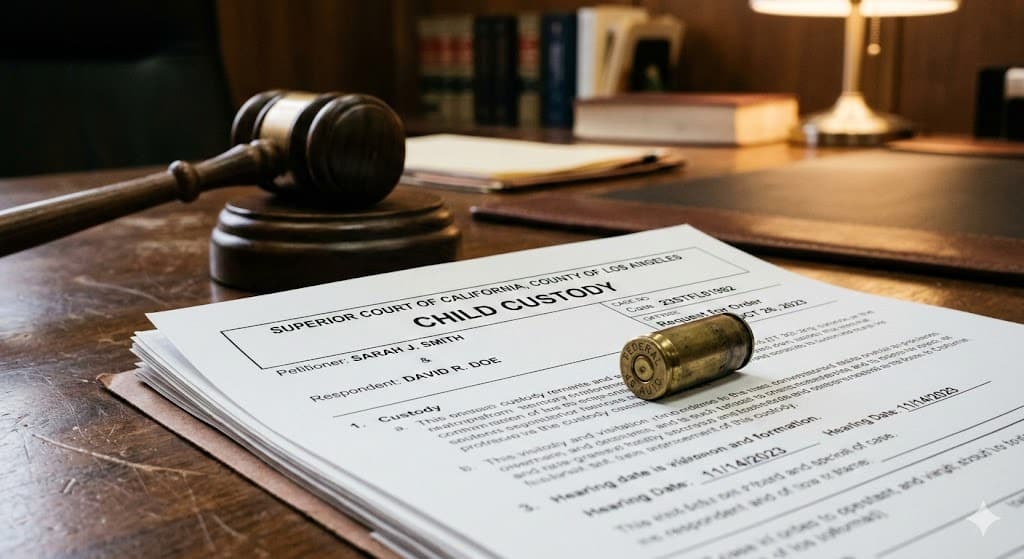
Under the updated law, a parent's illegal access to firearms—including possession that violates restraining orders, probation conditions, or state and federal statutes—can now directly influence custody outcomes. Courts already presume against granting custody to a parent who has committed domestic violence. The new provision strengthens that presumption by treating firearm violations as evidence of ongoing risk.
"A parent who violates a firearm restriction during a custody case isn't just facing criminal charges—they're handing the other side a powerful argument for sole custody," said Charles M. Green, a Certified California Family Law Specialist and licensed CPA with 27 years of experience in California divorce proceedings.
The law also works in conjunction with other recent legislative changes. Assembly Bill 2759, effective January 2025, requires immediate surrender of all firearms and ammunition when a domestic violence protective order is issued. Courts are now required to search the Department of Justice Automated Firearms System before issuing or denying protective orders—meaning violations are more likely to be discovered and documented. Assembly Bill 2308, also effective January 2025, extended the maximum duration of domestic violence restraining orders from five years to ten years, with the possibility of permanent orders in certain cases.
For parents navigating child custody disputes where domestic violence is alleged, compliance with firearm restrictions has become a critical factor in case strategy. A single violation—even one that does not result in criminal prosecution—can now be cited as grounds to deny custody or reduce parenting time. The burden falls on the accused parent to demonstrate that granting custody would be in the child's best interest.
"If you're going through a divorce involving domestic violence allegations, the first thing you need to do is understand exactly what firearm restrictions apply to you—and follow them to the letter," Green added. "The court isn't going to give you the benefit of the doubt. Compliance is everything."
The intersection of firearm law and family law reflects California's broader legislative focus on child safety in custody proceedings. Piqui's Law, enacted in 2023, already restricts reunification programs that place children with parents who have histories of abuse. The firearm provision adds another layer of protection by ensuring that violations of gun restrictions carry consequences beyond criminal penalties.
Parents facing custody disputes involving domestic violence allegations should consult with an experienced family law attorney to understand how these new laws may affect their case. Early legal guidance can help protect parental rights while ensuring full compliance with court orders and statutory requirements.
https://youtu.be/WEcWBYBUBw4?si=BqKX7CxQW4Ke3bf8
###
For more information about Charles M. Green, APLC, contact the company here:
Charles M. Green, APLC
Charles M. Green
213-387-4508
miguel@greenlawcorp.com
3699 Wilshire Blvd Ste 700
Los Angeles, CA 90010