As a powerful winter storm system brings extreme cold, high winds, and widespread travel disruptions across Midwestern states, Dr. Andrea Adams-Miller of The RED Carpet Connection LLC and The SubConscious Connection offers educational insight into how sudden weather extremes affect mental resilience, judgment, and emotional regulation. Dr. Adams-Miller, an applied neuroscientist and communication strategist, focuses on how abrupt environmental stressors activate cognitive responses that influence behavior at both individual and organizational levels.
The RED Carpet Connection LLC is an Ohio-based consulting firm that provides international education-focused guidance on public presence, messaging clarity, and leadership awareness for individuals and organizations operating in high-pressure environments. Its work centers on how mindset, perception, and situational awareness influence public interaction and response patterns during periods of uncertainty or rapid change.
Meteorologists and federal agencies report that recent storm systems affecting the Midwest meet the criteria of rapidly intensifying winter events marked by sharp drops in atmospheric pressure, dangerous wind chill, and hazardous travel conditions. The National Weather Service has warned that such systems can create prolonged disruption for households, businesses, and public services, increasing both logistical strain and emotional fatigue.
Dr. Adams-Miller explains that when environmental conditions change quickly, the brain shifts into a threat-response state designed for short-term survival rather than reflective reasoning. “The nervous system prioritizes immediate risk assessment when uncertainty rises,” she said. “That shift can reduce emotional regulation and make people more reactive in how they interpret information and respond to others.”
Peer-reviewed research supports the connection between environmental stress and cognitive performance. The Proceedings of the National Academy of Sciences by Porcelli and Delgado (2014) found that acute stress suppresses activity in the prefrontal cortex, the region responsible for planning, impulse control, and rational judgment. The authors concluded that stress narrows cognitive flexibility, affecting how individuals evaluate risk and process information under pressure.
Nature Climate Change by Clayton and colleagues (2017) examined the psychological impacts of climate-related stressors and identified increased anxiety, emotional fatigue, and cognitive overload during and after extreme weather events. The authors noted that repeated exposure to severe environmental conditions can strain emotional regulation and adaptive capacity over time.
Public health organizations have also acknowledged these effects. The American Psychological Association has stated that severe weather events can heighten stress responses, particularly when uncertainty and loss of routine persist. According to APA guidance, prolonged exposure to disruptive conditions can increase emotional strain even when physical safety is maintained.
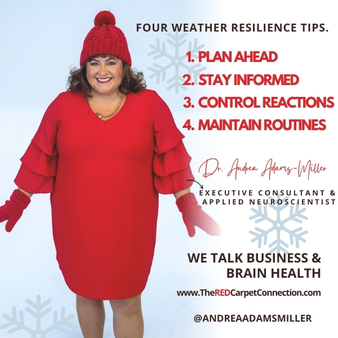
As the current storm continues to affect large portions of the Midwest, Dr. Adams-Miller emphasizes the importance of mental preparedness alongside physical readiness. She highlights, "Focusing on the four principles grounded in behavioral science that support steadier responses during extreme weather conditions includes planning, staying informed, controlling reactions, and maintaining routines. These principles reflect how the brain processes uncertainty and can help individuals and organizations maintain clearer thinking, steadier interaction, and more consistent responses as conditions evolve."
Through her work at The RED Carpet Connection LLC and The SubConscious Connection, Dr. Adams-Miller provides educational frameworks focused on clarity of messaging, emotional steadiness, and mindset awareness in high-stress situations.
Her approach helps individuals and teams recognize how subconscious patterns influence reactions to sudden change, including fear-based thinking or breakdowns in information exchange within families, workplaces, and leadership teams. The methods referenced are educational and not intended as medical or psychological treatment.
Dr. Adams-Miller also points to the broader societal implications of extreme weather. Recent national coverage has highlighted how winter storms disrupt supply chains, strain emergency services, and force business leaders and public officials to make rapid decisions.
Under these conditions, effective information exchange and emotional steadiness become increasingly critical. “Understanding how stress affects cognition helps people interpret information more accurately and respond more constructively under pressure,” she said.
As climate scientists and federal agencies continue to report increased variability and severity in weather patterns across the United States, conversations around preparedness are expanding beyond infrastructure and emergency response to include cognitive and emotional readiness. Understanding how stress, uncertainty, and disruption affect judgment and interaction has become increasingly relevant for communities, organizations, and leaders navigating prolonged or repeated extreme weather events.
Dr. Adams-Miller’s work contributes to this broader public discussion by emphasizing how awareness of brain-based stress responses can support steadier coordination and more resilient reactions during periods of widespread disruption.
About Dr. Andrea Adams-Miller
Dr. Andrea Adams-Miller is an applied neuroscientist, communication strategist, and international speaker specializing in brain-based communication, emotional resilience, and personal development. She is the CEO of The RED Carpet Connection LLC, an umbrella media and communications company overseeing The SubConscious Connection, a brain-based training company. She provides business consulting and training on mindset mastery, messaging clarity, and adaptive responses to stress.
###
For more information about TheREDCarpetConnection.com, LLC, contact the company here:
TheREDCarpetConnection.com, LLC
Dr. Andrea Adams-Miller
419-722-6931
AndreaAdamsMiller@TheREDCarpetConnection.com
8155 Township Road 89, Findlay, OH 45840